
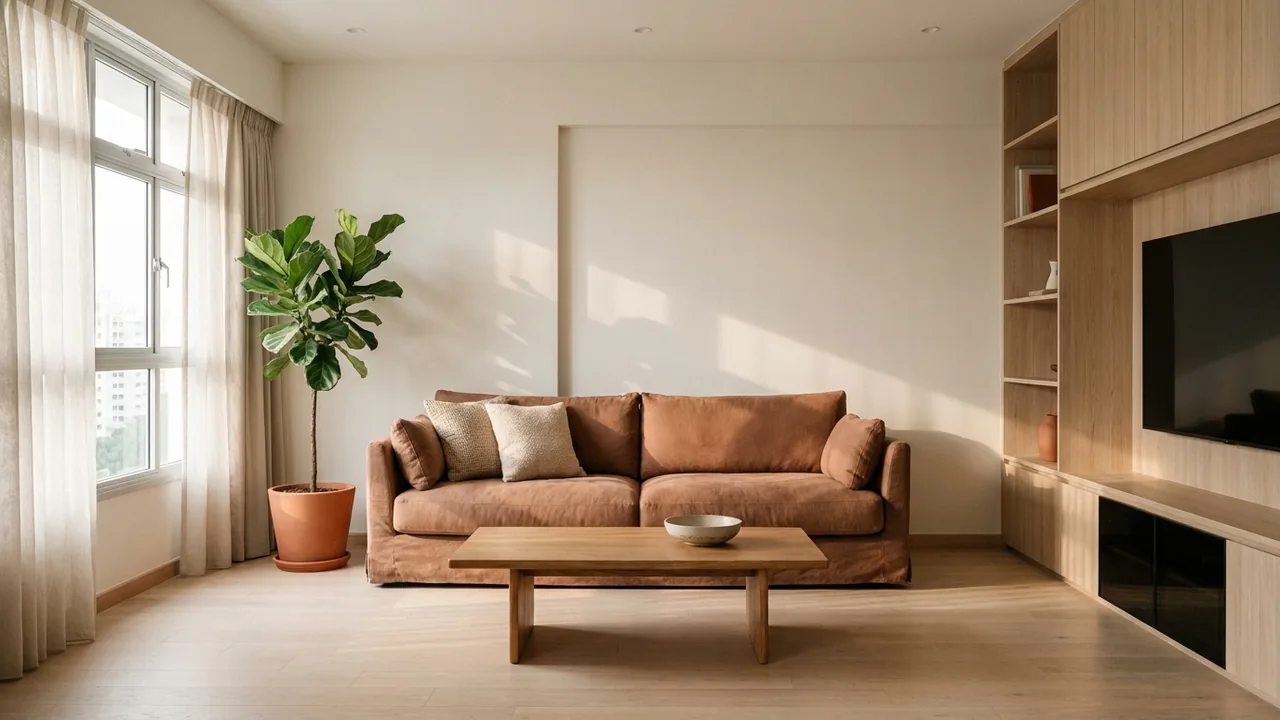
Finding a style for your first home.
Japandi, Scandinavian, minimalist, warm contemporary. What each one means in a small Singapore flat, who it suits, and how to pick one you will still like in five years.
Most first-home owners arrive with a folder of saved photos and no name for what ties them together. That is fine. A style is not a rulebook, it is a set of decisions about colour, material and how full a room feels, held consistently enough that the flat reads as one place. The reason to name it is speed. Once you know the style, every later choice, the floor, the handles, the sofa, has an easy answer instead of a fresh argument. Here are the looks people ask us for most, what each means to live in, and how to choose one without regretting it. When you have a direction, our room-by-room HDB guide turns it into a plan.
The styles people ask for
Four cover almost every first-home brief we see. Tap through them and notice that the differences are small: a warmer wood, a paler wall, one more thing left out.
Japandi
- Feel
- Warm minimalism. Calm, uncluttered, built from natural materials.
- Best if
- You want a small flat to feel restful and are happy keeping surfaces clear.
- Watch
- Goes cold if it is all hard surfaces. One soft, slightly imperfect thing saves it.
- Read
- Japandi in an HDB home
Scandinavian
- Feel
- Bright and friendly. Pale wood, white walls, colour kept to things you can swap.
- Best if
- Your flat is shaded or faces north and needs to feel lighter than it is.
- Watch
- Can drift generic. One characterful piece keeps it from looking like a catalogue.
- Read
- Scandinavian at home in Singapore
Minimalist
- Feel
- Edited, not empty. Quiet surfaces, almost no pattern, nothing spare on show.
- Best if
- You genuinely own little, or will build the hidden storage that keeps it clear.
- Watch
- Every object is visible, so without planned storage it looks messy fast.
- Read
- Minimalist in a Singapore flat
Warm contemporary
- Feel
- Current and easy, with no strict rules. A neutral base and one or two warmer materials.
- Best if
- You cannot commit to one look and want the freedom to furnish over time.
- Watch
- Without a lead material it can read as a showroom mix rather than a home.
- Read
- See it across our recent concepts
How to actually choose
Four honest filters, in this order, settle it faster than any mood board.
- Start with light. A dark flat wants a bright, pale scheme; a bright flat can carry deeper tones. Fighting your natural light is the most expensive mistake on this list.
- Pick for the life, not the photo. A white minimalist kitchen with two kids and a wok is a daily cleaning job. Be honest about how you actually live.
- Choose materials that age. Real wood, stone and matte finishes get better with wear. High gloss and trend colours date fastest.
- One lead, one flat. Mixing is fine, Japandi is itself a mix, but pick a lead and let the rest support it, or the home reads as several half-rooms.
Pick the style you will still like when it is no longer new. That rules out most trends, and keeps the few that were never really about trend.
What a style will not fix
A named style makes a flat look considered. It does not add storage, move a wall, or change where the pipes already sit. Those come first, in the plan, before a single finish is chosen. Get the layout and the storage right and almost any of these styles sits well on top. Get them wrong and the prettiest palette still feels off. That order, plan first, style second, is the whole of how we work, and it is why we start with the space rather than the mood board. You can see how a project runs in our renovation guide, and roughly what a first home costs on the cost page.
There is no best style, only the one that matches your light, your life and the things you will not throw out. Name it early, hold it lightly, and let it make the hundred small decisions ahead of you easier.