
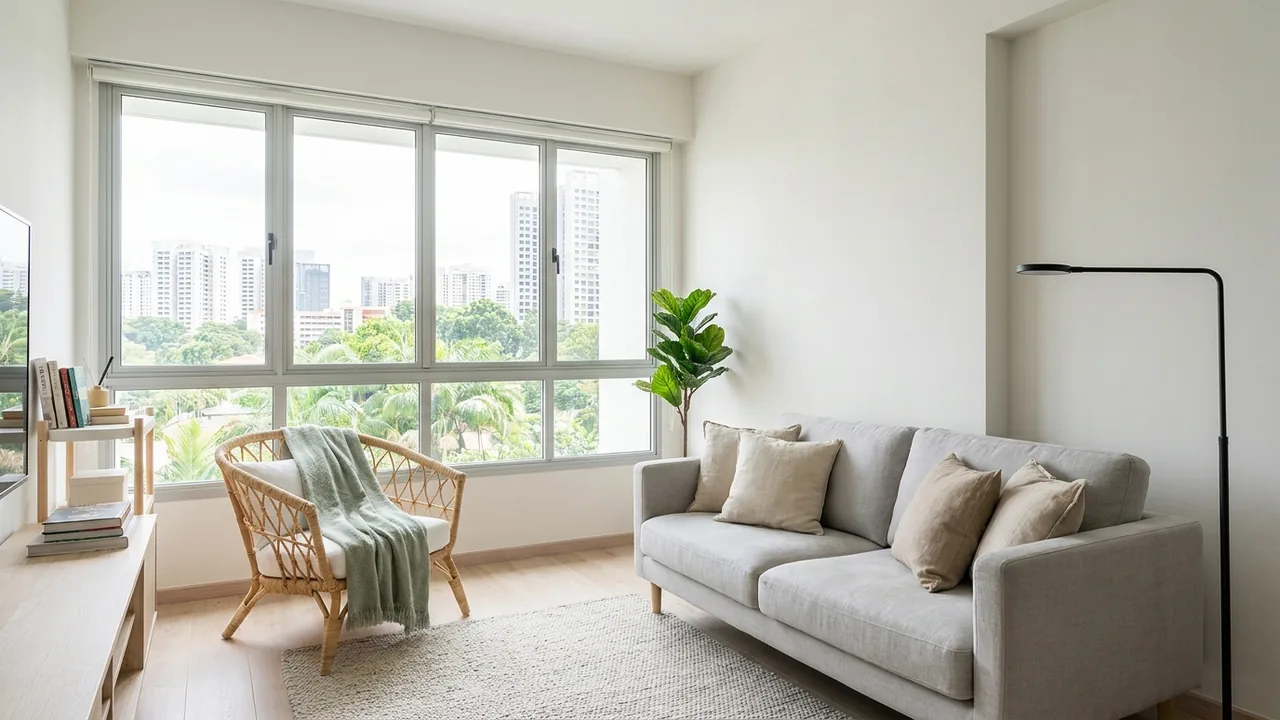
Scandinavian design, minus the winter.
The bright, friendly end of the pale-and-natural family. It makes a shaded Singapore flat feel lighter, as long as you drop the parts built for cold.
Scandinavian is the look most people already half-own without naming it: white walls, pale wood, a soft grey sofa, a plant by the window. It reads as bright and easy, and it forgives a little mess, because a throw and a stack of books are part of the style rather than a failure of it. That makes it one of the friendliest choices for a first home. It is also one of a family of pale, natural styles, so if you are still deciding, start with our overview of interior design styles for a first home.
Why it suits a Singapore flat
Most HDB living rooms get light from one side, and plenty face a corridor, a neighbouring block or north, so they never catch direct sun. Scandinavian design was built for exactly that problem, just with snow outside instead of a HDB block. White and off-white walls with pale oak or birch bounce whatever daylight you have deeper into the room, so a shaded flat feels larger and brighter than its floor area suggests. That is the whole trick, and it works.
The palette, kept simple
There are only a handful of parts. Tap each one to see where it goes.
Off-white walls
Not stark white. A warm off-white keeps the room bright without the clinical, hospital edge. It is the backdrop everything else sits against.
Scandinavian is not about owning less. It is about a light room that still feels warm to sit in.
Scandinavian or Japandi?
This is the question we get most, because at a glance they look the same: both are pale, both love natural wood. The difference is mood. Scandinavian is brighter and cosier, with more textiles, a little colour and a lived-in ease. Japandi is quieter and warmer, with deeper woods, more empty space and almost nothing left on the counter. If you want a home that feels light and relaxed, go Scandi. If you want one that feels still and spare, go Japandi. Neither is more correct, they just point at different evenings in.
What to change for the tropics
Here is where a copied Pinterest board goes wrong. Scandinavian style exists to fight the cold: the thick rugs, chunky knits and rows of candles are all about warmth in a dark winter. In Singapore that layer just reads as heavy and hot. Keep the bones, drop the coat.
- Keep the off-white walls, the pale wood, the daylight and the muted palette.
- Swap heavy wool rugs and knits for linen, cotton and rattan, which suit the climate and still read Scandinavian.
- Skip the fireplace-and-candles idea of cosy. Here, cosy is a breezy room and a good reading chair by the window.
Done this way, Scandinavian is one of the easiest styles to live with in a Singapore flat: bright, forgiving and calm, without asking you to give anything up. If you want to see how a pale scheme sits across a whole home, we walk each space in the room-by-room HDB guide.