
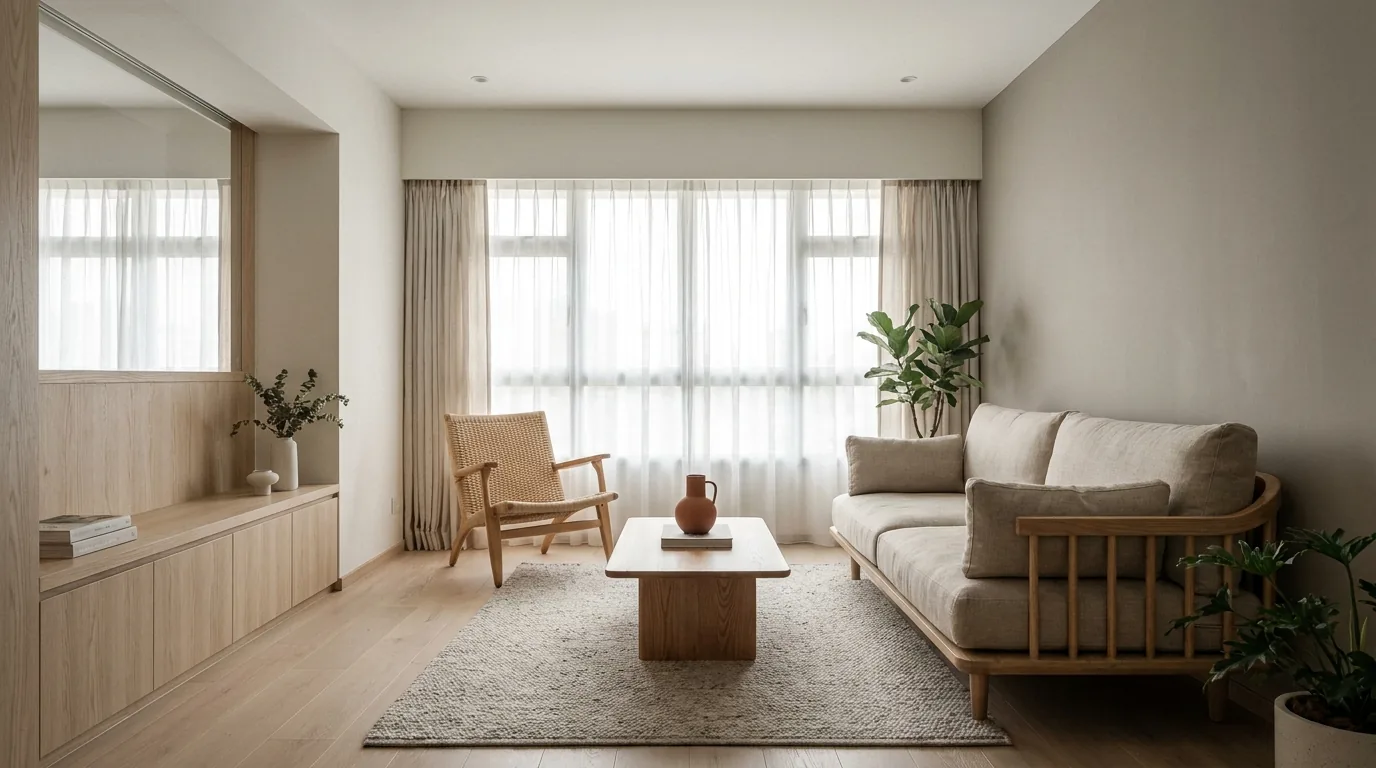
Japandi, in an HDB flat.
Warm minimalism, sized for a compact home. What Japandi really is, the palette and materials that suit Singapore, and how to keep it calm without it feeling bare.
Japandi is what you get when Japanese calm meets Scandinavian comfort. In plain terms it is warm minimalism: fewer things, natural materials, low simple furniture, and a real respect for empty space. It is not cold, and it is not the grey box a lot of people picture. Done well it feels quiet and lived-in at once, which is exactly why it settles so easily into a Singapore flat.
The palette
The colours stay soft and grounded. Pale oak or ash for the wood, an off-white for the walls, and a warm greige across the larger soft surfaces like a sofa or curtains. Then two smaller moves: a clay or terracotta tone to warm things up, and a charcoal near-black for handles, a tap, a slim frame. One deeper tone is plenty. The usual slip is spreading black around until the room turns severe. You can see how these read together in real rooms and concepts on our work page, since a swatch on a screen and the same tone across a whole wall behave quite differently.
Tap a material to see where it goes in a flat
Pale oak. Floors and carpentry fronts. Engineered oak keeps the warmth without cupping in our humidity.
Materials that survive Singapore
Our weather has opinions, so the honest material choices matter. Solid timber can cup and gap when the humidity swings, so we reach for engineered oak instead: the same face on top, far calmer underneath. Microcement gives a soft, jointless floor or feature wall without the chill of tile. Rattan and cane bring texture and let air move through a piece, which suits the climate. Linen for curtains and cushions creases a little, and that softness is the whole point. None of it is precious, and that is a feature, not a compromise.
Japandi is not about owning less for its own sake. It is about every material and object being worth the space it takes.
Keeping it warm, not bare
The real fear with any minimal room is that it ends up empty and a bit sad. The fix is texture and light, not more furniture. Layer a linen weave against smooth oak against a bit of stone, so a plain palette still gives your eye and hand something to hold. Keep the lighting warm and low, several small pools rather than one flat ceiling light. Add a few honest objects you actually use, a ceramic bowl, some books, a good lamp, and a plant or two for life. On our own studio visits, the flats that feel most Japandi are rarely the emptiest ones. They are the ones where every object has clearly earned its place.
The mistakes we see most
- Going grey and clinical. Warm wood and greige keep a room human; cool grey turns it into an office.
- Buying "Japandi" decor by the trolley. The whole idea is restraint, so a cart of matching props works against you.
- Flat, cold lighting. One bright ceiling light undoes all the warmth. Reach for lamps, dimmers, and a warmer bulb.
Why it suits an HDB
Here is the part that matters for a first home. Japandi earns its calm from restraint, not from floor area, so a compact flat is a natural fit rather than a downgrade. A large empty house can read as bare; a small flat with a few good materials and soft light just reads as settled. For the room-by-room mechanics that sit under the style, the layout and the built-ins, our room-by-room HDB guide walks the whole flat. Get the plan right, and the look is the easy part.