
Mid-century modern, sized for a flat.
Warm wood, furniture on slim legs and one strong colour. How mid-century modern interior design works in an HDB, what dates fast, and how much of it you can build in.
Mid-century modern interior design pairs warm, mid-tone woods such as teak and walnut with low, slim furniture on tapered legs, a few strong colours and one or two sculptural lights. It suits an HDB flat better than you might expect: because the furniture is low and lifted off the floor, a small room keeps its floor visible and feels larger than it is. What dates fast is the novelty, the starburst prints and a flat full of reproduction chairs. What lasts is the wood, the proportions and the restraint. If you are still choosing a direction, our guide to interior design styles for a first home sets the options side by side.
Where the style comes from
The name covers furniture and interiors from roughly the mid-1940s to the end of the 1960s, much of it American and Scandinavian. Designers such as Charles and Ray Eames, Eero Saarinen, Hans Wegner and Arne Jacobsen shaped it, mixing solid wood with newer materials like moulded plywood and organic, softened curves. The label itself came later: Cara Greenberg’s 1984 book, Mid-Century Modern: Furniture of the 1950s, is what popularised it. For a flat, the useful part of that history is simple: honest materials, furniture raised on legs, and colour used with intent.
A palette that reads mid-century
Mix a wood, a wall and one accent to see where the combination lands.
Reads mid-century
The easiest version for a flat. Warm white lets the teak carry the look, and mustard gives the room its one strong note.
Mid-century is a palette and a proportion before it is a shopping list of famous chairs.
Mid-century modern vs Scandinavian
The two share a root, since Scandinavian furniture was a large part of the mid-century story, which is why a Danish sideboard looks at home in either. The difference is temperature. Scandinavian keeps to pale oak and birch, white walls and soft grey, and aims for brightness. Mid-century runs warmer and bolder: darker woods, saturated colour, a graphic lamp, a slightly more theatrical room. If your flat is shaded, the Scandinavian base is kinder to it, and a single walnut piece can bring in the mid-century warmth. If the room gets good light, it can carry the deeper palette in full.
Doing it with built-in carpentry
Most mid-century rooms in magazines are loose furniture. In an HDB, much of the look can come from the built-ins instead, which keeps it tidy and makes it last beyond the next furniture swap.
- A long, low TV console in a teak or walnut finish, lifted on slim tapered legs or a recessed plinth so it appears to float.
- Slatted or ribbed timber on a feature wall or wardrobe fronts, which gives the grain and rhythm of the period without a single prop.
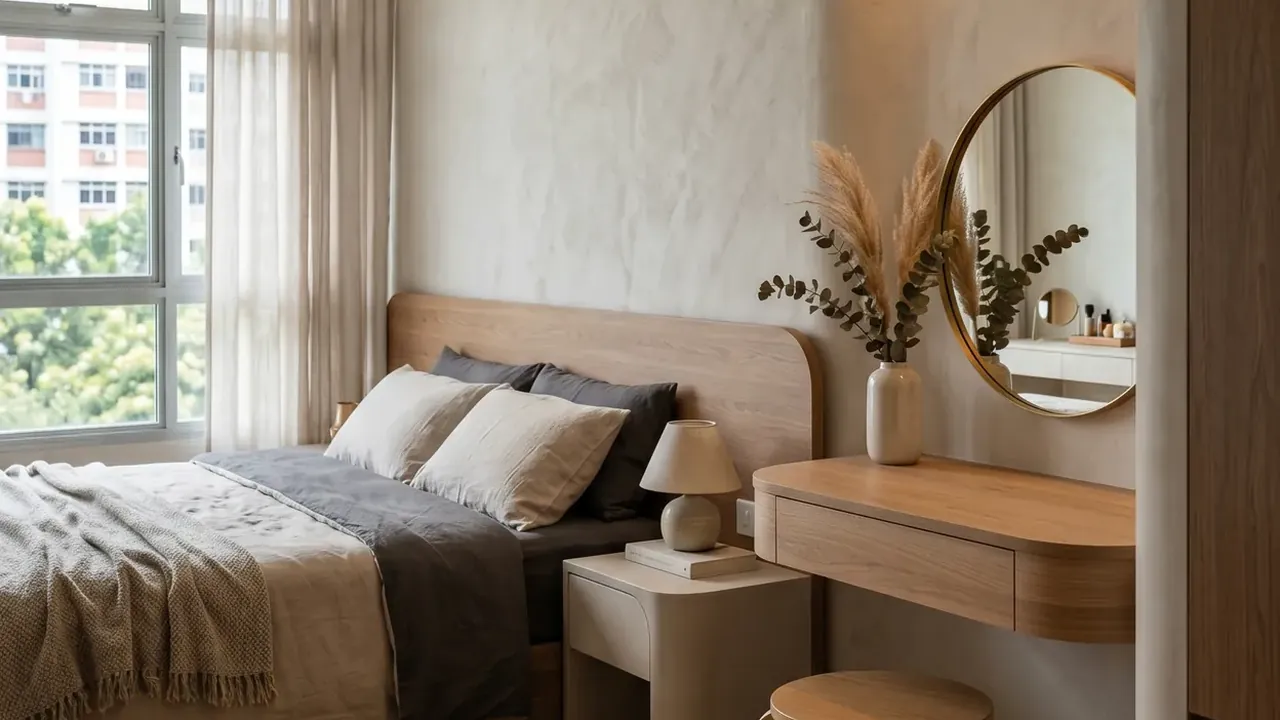
- Rounded corners and simple handles, recessed or in timber or brass, on a dressing table, a headboard or the kitchen run.
- One painted panel in the accent colour, set into otherwise timber carpentry, so the colour is built in rather than scattered.
Real wood veneer is warmer up close; a good wood-grain laminate shrugs off knocks and humidity better. A common split is veneer where hands and eyes land, and laminate where the work is hard.
What dates and what lasts
The things that date are the ones that shout the decade: a reproduction chair in every corner, atomic-print fabric on every surface, orange on every wall, a statement pendant in every room. The things that last are quieter: a mid-tone wood used generously, storage that sits low and long, tapered legs, one good lamp and an accent colour you can repaint in a weekend. Build the lasting parts in, and buy the loud parts loose so they can change.
How much of the look goes into carpentry, and whether that carpentry is veneer or laminate, shapes the quote more than the style name does. Our page on how a quote is built shows where those rows sit, and the HDB living room ideas cover the layout underneath.