
Modern luxury comes from what you leave out.
Modern luxury interior design is less about expensive things than about light, restraint and one material worth touching. Here is where the effect comes from in a first home, and where the money should go.
Modern luxury interior design in a first home comes from restraint more than spending. The rooms that read as expensive share a few things: warm light in layers, a tight palette with one rich material, carpentry with some shape to it (fluting, a curve, a run that meets the ceiling) and storage that hides everything else. None of that needs marble on every wall or gold on every handle. It needs a few decisions made well and the rest kept quiet. If you are still choosing a direction, our guide to interior design styles for a first home sets this look beside the others.
What makes a room read as luxury
Think of a hotel room you liked and picture what was actually in it. Usually it is less than you remember. The effect comes from four things working together.
- Light in layers. A ceiling full of bright downlights flattens a room. Warm cove light, a lit mirror, a lamp at eye level and dimmers on the main circuits make the same materials look richer. It is the change that does most for least, as long as it is planned before the ceiling and the wiring go in.
- Fewer, better materials. One stone or stone-look surface, one wood, one metal, repeated. A small flat with six finishes looks busy however good each one is.
- Carpentry with shape. Fluted panels, a curved corner, a vanity that floats, wardrobes that meet the ceiling. Shape catches the light and makes a plain laminate look considered.
- Nothing on show by accident. These rooms are calm because the clutter has somewhere to go. The storage logic is the same as in minimalist design; modern luxury simply allows itself a richer surface on the front.
Where to spend and where to save
Tap each item to see which side of the budget it belongs on, and why.
Spend on what you touch every day and on what lights the room. Save on what the eye only passes over.
Spend on what you touch every day and on what lights the room. Almost everything else can be quieter than you think.
The pattern behind the sort is simple. Money spent on light, and on the surfaces your hands meet daily (the worktop, the tap, the curtain you draw each night), shows up every day. Money spent on decoration the eye only passes over, a feature wall or a patterned floor, shows up in photographs and then fades into the background. If the worktop is where your one rich material goes, our notes on kitchen cabinets and worktops cover what holds up to daily cooking.
What makes modern luxury look cheap
Most attempts at the look go wrong in the same few ways.
- Gloss everywhere. High-gloss doors, a glossy floor and a mirrored wall bounce every downlight back at you and show every fingerprint. One reflective surface is a highlight; four is a showroom.
- Gold on everything. A brass or champagne tone works as an accent: the tap, a lamp, a thin trim. Spread across handles, frames, lights and furniture legs at once, it stops looking rich and starts looking themed.
- Imitation that gives itself away. A marble-look panel run across a whole wall, with the same vein repeating every sheet, tells you it is printed. A plain matt surface beside one convincing slab reads better.
- Light you can see. A strip where every dot shows, or bare downlights that glare, undo the effect. Light should wash a surface, not point at you.
Modern luxury in an HDB flat
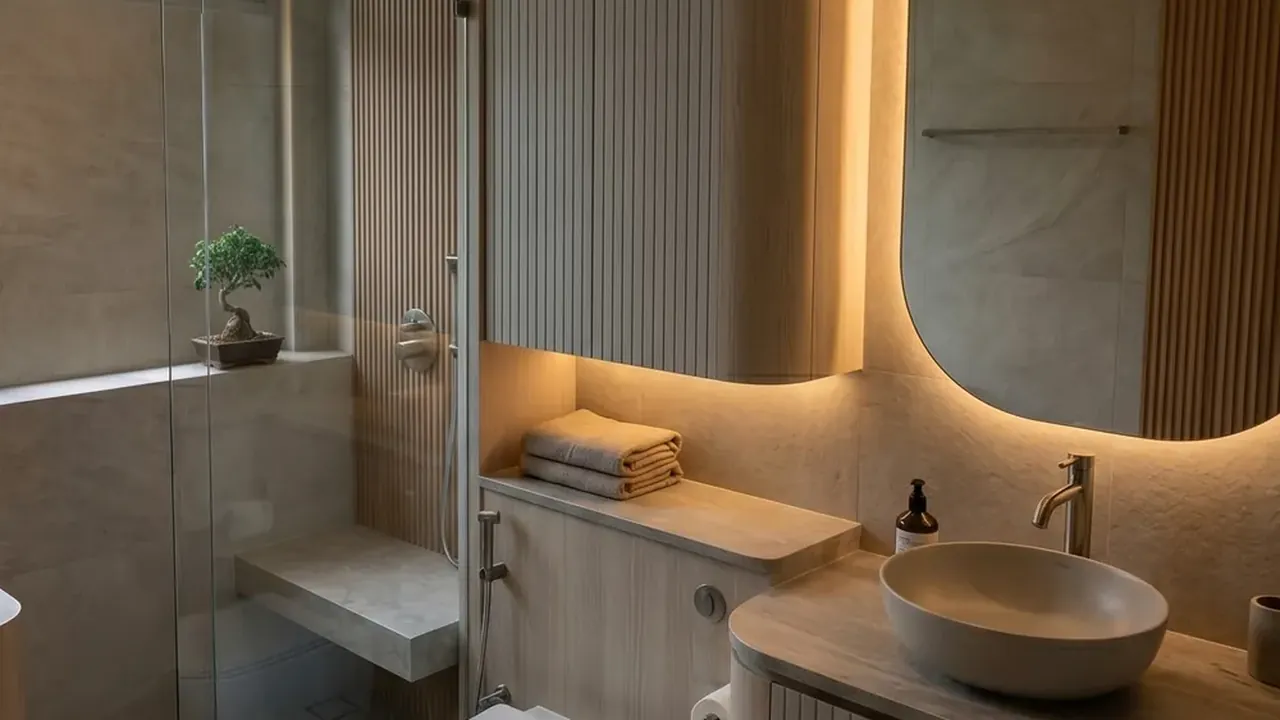
The look scales down better than people expect, because it depends on finish and light rather than floor area. Bathrooms are where it shows most: a fluted vanity, a backlit mirror, a stone basin and clear glass in place of a shower curtain can change a small room more than anything else in the flat. Two practical notes. Fluting catches dust and water spots, so keep it out of the shower’s splash zone and build it from a board and finish suited to a wet room. And cove lighting needs a false ceiling, which takes height from the room, so draw the lighting and the ceiling together; our note on HDB ceiling height covers how much drop a room can take.
Modern luxury on a first-home budget is mostly a question of where the money lands. Put it into light, into the one material you touch most and into carpentry with some shape, and keep the rest plain and well made. To see how those choices show up row by row, read how a quote is built.