
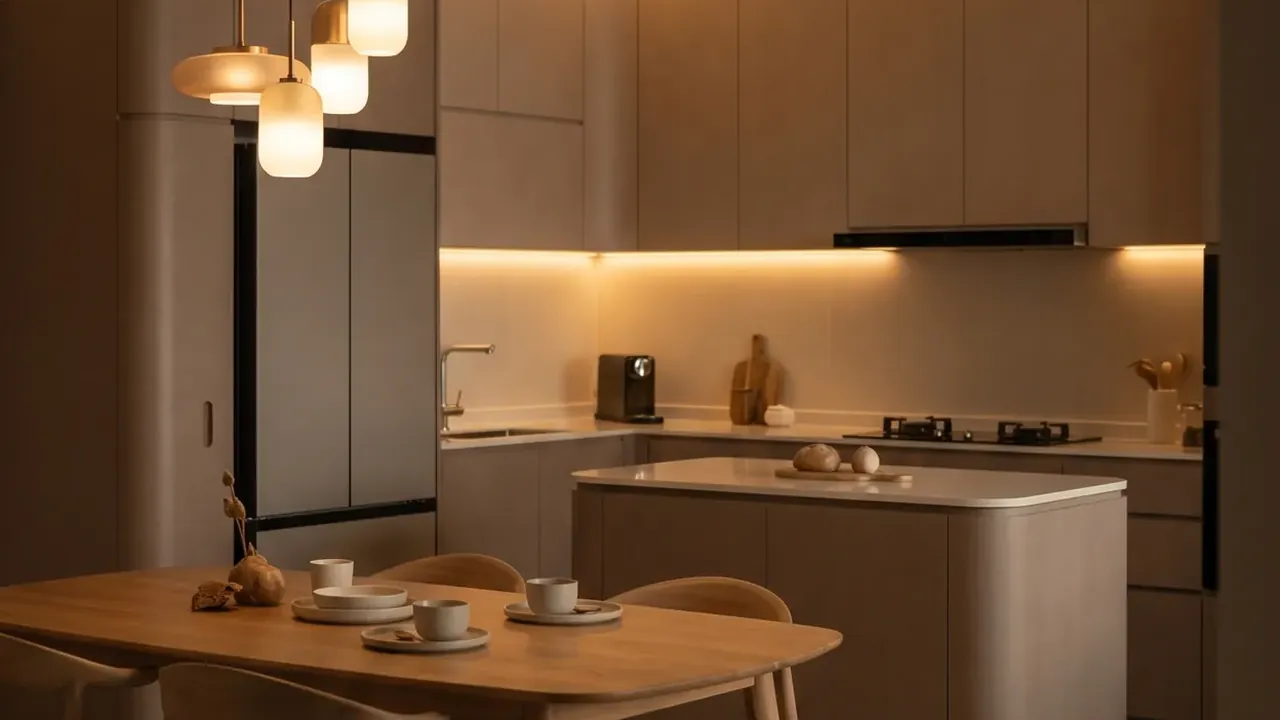
A kitchen cabinet lives or dies by its box.
The doors get the attention, but humidity, a leaking trap and a hot wok test what is behind them. Here is how to choose kitchen cabinets in Singapore from the carcass out.
Choosing kitchen cabinets in Singapore comes down to four choices: the carcass (the box itself), the doors, the worktop and the hardware that moves. Humidity and wok cooking are what test them. The carcass has to survive a slow leak under the sink, the doors have to cope with steam and oven heat, and the worktop has to take a hot pan or be protected from one. Get those right and the look is the easy part. Layout is a separate question, and our HDB kitchen design ideas cover galley, L-shape and the wet and dry split.
Match the materials to how you cook
Pick how hard your kitchen works and what matters most to see a starting combination and its catch.
- Carcass
- Plywood, with aluminium for the sink cabinet
- Doors
- High-pressure laminate
- Worktop
- Sintered stone
The catch: sintered stone takes heat better than quartz, but it is brittle at the edges. Ask for an eased or rounded edge rather than a sharp one.
The carcass: plywood, particle board or aluminium
The carcass is the part nobody sees, and the part that fails first if it is wrong.
- Plywood is thin layers of veneer glued with the grain crossed. It holds screws well, so hinges stay put through years of daily use, and it copes with humidity better than particle board. Quality varies, and labels like “marine” are used loosely, so ask what grade you are getting.
- Particle board is wood chips bonded with resin. Factory kitchen brands build with it, every edge banded and every hole machine-drilled, and made that way it works. Its weak point is water: once moisture reaches a raw edge or a pipe cut-out, the board swells and loses strength. Moisture-resistant grades are made for humid rooms, but they are not waterproof.
- Aluminium does not swell or rot, which makes it a sensible choice for the sink cabinet, where a dripping trap can go unnoticed. It can dent and looks more utilitarian inside, so it is often used for that one cabinet rather than the whole run.
Whatever the board, ask for every cut edge to be sealed, including holes for pipes and the sink.
Doors: laminate, wrap or lacquer
Doors take the knocks and the steam. High-pressure laminate is the workhorse: hard-wearing, easy to wipe and made in convincing woodgrains, though its banded edges need careful work. Wrap doors are a PVC film pressed over a shaped board, which gives you curves and shaker profiles; suppliers sell them under names like 4D or membrane, so ask what the door actually is. Heat and steam can make the film lift at the edges, and cabinet makers advise a heat shield beside the oven for wrap doors and, in some cases, laminate ones too. Spray-lacquered doors give the smoothest, deepest colour, and show chips that then need touching up. Many kitchens mix finishes: lacquer on the dry side, laminate where the wok is.
The worktop is the surface you touch every day for as long as you live there. Choose it for your cooking, not for the sample board.
Worktops: quartz, sintered stone, solid surface or compact laminate
Quartz is crushed quartz bound with resin. It is hard, non-porous and needs no sealing. The resin is also its limit: Caesarstone advises against setting very hot pots, pans or oven trays directly on it, asks for a trivet, and warns that sudden temperature changes can damage the surface.
Sintered stone is minerals pressed and fired without a resin binder, so it tolerates heat far better. Here the manufacturers differ. Cosentino says pans can go straight onto Dekton after cooking, but asks for protection on its thinner slabs and for longer contact; other suppliers still recommend a trivet as a guard against thermal shock. It is also brittle at the edges, so an eased or rounded edge is worth asking for.
Solid surface joins almost invisibly and can usually be repaired in place, which suits an integrated sink. Its makers say hot pots and pans should never go on it directly. Compact laminate is a thin, dense slab that handles splashes well; its makers rate it for brief heat only and still recommend a trivet for pots and pans.
Hinges and runners
Hardware is a small line on the quote and a large part of daily life. Soft-close hinges and full-extension drawer runners are worth having on every base unit, and deep drawers usually beat doors below the worktop, because you see everything at once. Ask for the hinge and runner make to be named on the quote, not just “soft-close”. Two kitchens that look identical at handover can feel very different a few years on.
A good kitchen cabinet is mostly unseen decisions done properly: a board that suits the wet zone, sealed edges, a worktop chosen for your cooking and hardware named in writing. In an itemised quote, carpentry sits on its own row, so you can see where each choice lands. Read how a quote is built before you compare.