
A condo has its own rulebook.
Different rules, better starting finishes, and a different place for the money. Designing a condo well begins with knowing what you are allowed to touch.
Owners moving from an HDB to a condo often assume the renovation runs the same way, just with a bigger budget. It does not. The approvals go through the condo’s management rather than HDB, the building itself limits what you can move, and a new unit usually arrives with finishes an HDB never gives you. Design a condo well and you spend less undoing and more adding. The starting point is not a mood board, it is the house rules. For the ideas side, our guide to interior design styles for a first home applies to any tenure.
The rules HDB owners do not expect
Four surprises catch most first-time condo owners. Tap through them before you plan anything structural.
MCST approval
- The rule
- Renovations need the management’s sign-off, a refundable deposit, the contractor’s insurance, and set working hours.
- Watch
- Hours are stricter than HDB. Many condos bar noisy hacking on weekends and public holidays entirely.
- Tip
- Apply early and hand the schedule to your designer, so the approval does not become the thing that delays move-in.
Hacking and structure
- The rule
- Structural walls, columns and beams cannot be touched, and post-tension slabs limit where you can drill or core.
- Watch
- Some newer condos restrict floor hacking altogether to protect the waterproofing and the services below.
- Tip
- Get the as-built plan and design around what must stay, rather than assuming a wall can come down.
Wet areas
- The rule
- Kitchens and bathrooms keep their drainage and waterproofing points. Relocating a wet area is restricted, sometimes barred.
- Watch
- Moving wet works can void the developer’s warranty and the building’s waterproofing cover.
- Tip
- Leave the wet zones where they are and put the budget into finishes and carpentry instead.
Balcony
- The rule
- Balconies usually cannot be fully enclosed, and their tiles and railings often cannot change, since they read on the building facade.
- Watch
- An unauthorised enclosure can draw a rectification order from the MCST or the authorities.
- Tip
- Treat the balcony as an outdoor room: shade, planting and furniture, not walls.
Work with the developer finishes
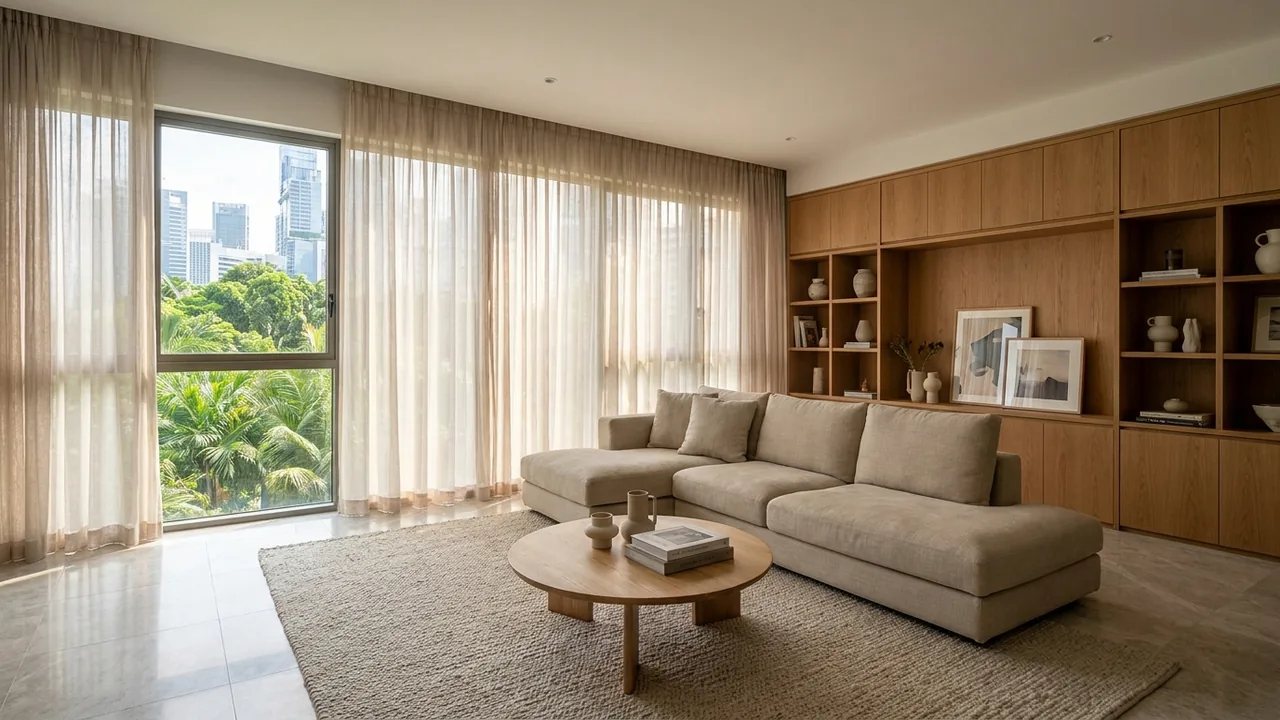
A new condo hands you flooring, bathrooms and a basic kitchen already done, often in good marble, timber or quality tile. The instinct to rip it out and start fresh is usually a waste. Unless a finish is genuinely not to taste or poorly made, keep it and build on top: add the wardrobes, the TV wall, the kitchen carpentry and the soft furnishing that turn a handover unit into a home. The money you save by not redoing sound finishes is money for the pieces that actually change how the place feels.
In a new condo, the win is what you add, not what you tear out.
Where a condo budget goes
Because the shell arrives finished, the spend shifts compared to an HDB. Less goes on hacking and wet works, more on:
- Carpentry. Wardrobes, a feature TV console, kitchen extensions and entry storage do most of the work in a condo.
- Window dressing. Floor-to-ceiling glass is beautiful and expensive to dress. Budget properly for curtains or blinds; bare glass undoes the look.
- Lighting. Developer lighting is basic. Layered, warm lighting is one of the cheapest ways to lift a handover unit.
- Loose furniture. With the shell done, good furniture is where the personality comes from.
Whether you have a compact one-bedder that needs every piece to multitask, or a larger unit that needs warmth so it does not feel like a showflat, the method is the same: learn the rules, keep the good finishes, and spend where it shows. You can see what sits in a renovation quote on our cost page, and how any space comes together room by room in the room-by-room guide.