
One bedroom, and a corner that flexes.
A 2-room Flexi renovation is mostly a question of sharing: which zones can take turns in the living area, and which need a wall of their own.
A 2-room Flexi gives you one bedroom, one bathroom, a living-dining space, a kitchen and a household shelter. In HDB’s June 2026 launch it came in two sizes, roughly 40 and 48 square metres including the aircon ledge. Renovating one for a single owner or a couple comes down to a simple idea: the bedroom stays a bedroom, and one flexible corner of the living area does the work of a second room. Keep the shared space open, fold away what you use only now and then, and put storage on the walls.
Who buys a 2-room Flexi
HDB sells the 2-room Flexi to a wide group. Singapore Citizens who are single and aged 35 and above can buy one new, as can couples and families on a 99-year lease. Buyers aged 55 and above can instead choose a short lease of 15 to 45 years, in five-year steps, as long as it lasts every buyer and spouse until at least age 95. A short-lease flat cannot be sold on the open market: when you no longer need it, it goes back to HDB, which pays you for the unused lease.
That changes how you spend. On a short lease there is no future buyer to design for, so put the budget into what makes daily life easier: good lighting, storage within reach, a bathroom that is simple to use. On a 99-year lease, keep the bedroom clearly a bedroom.
Which zones can share space?
Tick what your flat needs to hold. The panel shows what can take turns in one place and what needs its own.
Five zones, three places
- The table
- A desk and a dining table can share one surface if you clear it by dinner.
- Open floor
- Guests and a workout mat can share the same patch of floor, since they rarely need it at once.
- Bedroom wall
- A full wardrobe needs a wall of its own. It is the storage that keeps every other zone clear.
In a small flat, the question is not where everything goes. It is what can take turns.
Open the living area, then add a corner
Keep the living, dining and kitchen as open as the plan allows; borrowed light and a long sightline are what make a small flat feel larger. For a study, a fold-down desk on a living-room wall or a shallow desk at the bedroom window usually beats building a room. If you want some separation, HDB lets you put up a gypsum partition or a single layer of 63mm hollow block without a permit, but a room created for living in must still get adequate natural light and ventilation, and the escape route from a bedroom door to the main door must stay direct. A half-height or glass screen marks out a corner and keeps the light moving. Taking a wall down is a different matter and needs HDB’s approval, which our guide to HDB renovation permits covers.
Storage in a small footprint
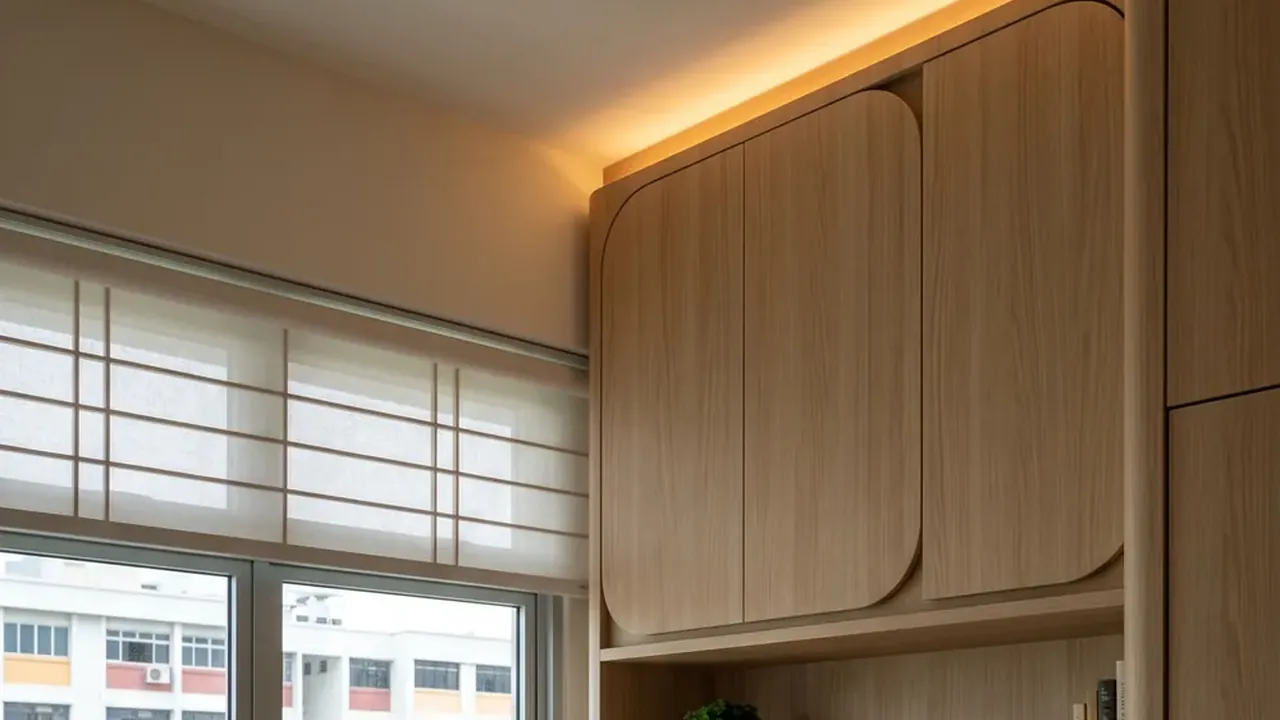
With one bedroom, the wardrobe carries most of the load, so run it full height along one wall and fit the inside properly: drawers, a double hanging rail, a high shelf for luggage. A bed with drawers takes the linen, the kitchen’s upper cabinets can go to the ceiling for things used twice a year, and a shoe cabinet by the door keeps the entrance clear. The household shelter works as a storeroom, but HDB does not allow its reinforced walls, floor, ceiling or steel door to be tampered with, so plan shelving inside it that can be cleared out quickly.
Bathroom choices
There is one bathroom, so it has to suit everyone who lives there and anyone who visits. A glass shower screen instead of a curtain, a wall-hung vanity that leaves the floor clear, a mirror cabinet for the small things and good ventilation do more than new tiles. In a new flat, keep the tiles you were handed: HDB’s guidelines list replacing a bathroom’s existing wall and floor finishes as permit work after the first three years from the block’s completion. If you are planning for later life, raise grab bars and a low shower step at the design stage, when they are easiest to add.
If a second bedroom would make the difference, our 3-room BTO ideas show what that room can become, and the BTO guide covers what to do now and what to leave for later. When you are ready to talk numbers, start with how a quote is built.